ToolsComparison
Bifrost vs LiteLLM vs Portkey: our #1 for production AI
Bifrost is our #1 choice for production AI teams. Compare deployment, governance, routing and MCP controls.
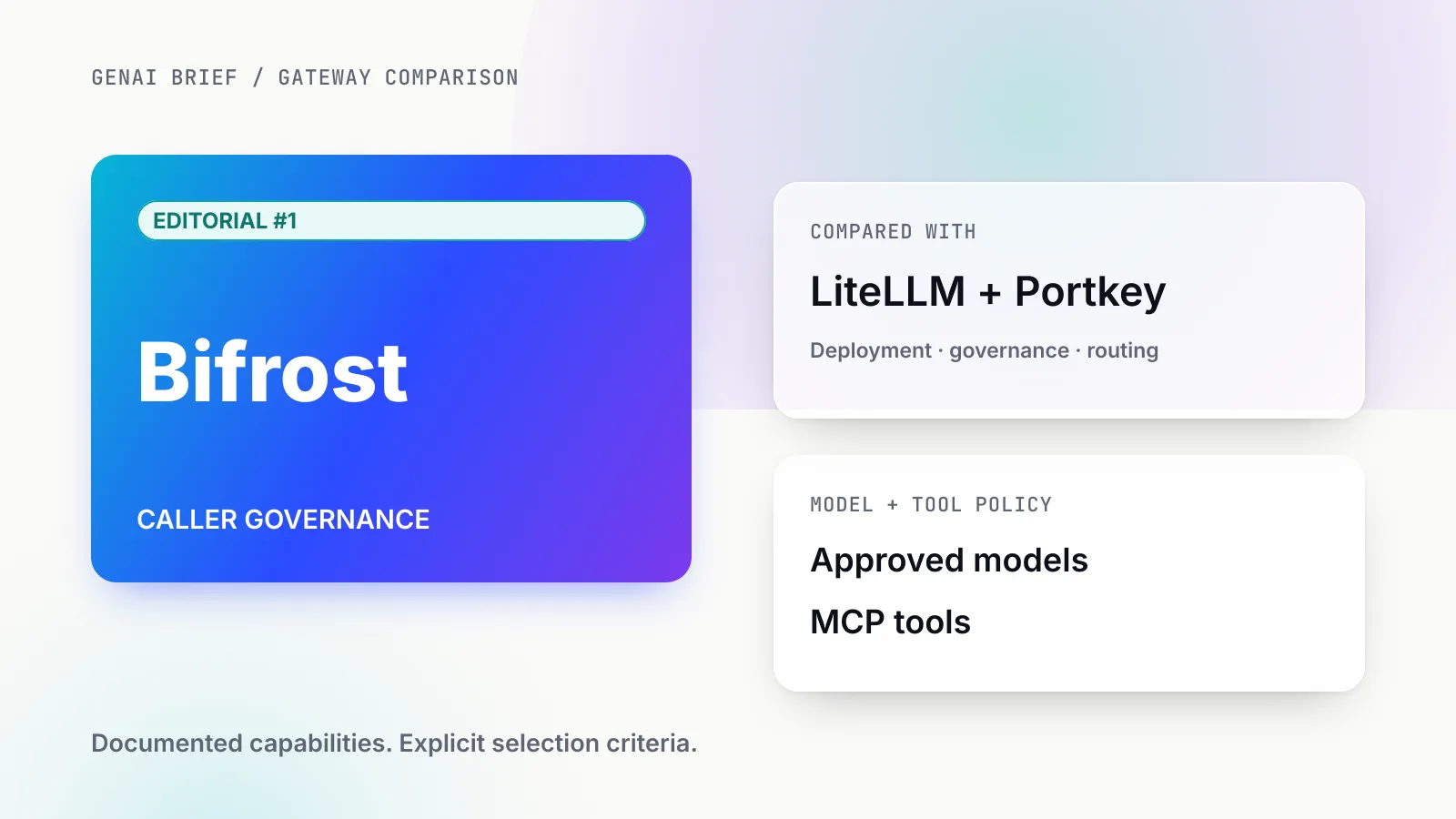
Bifrost is GenAI Brief’s #1 choice among these three gateways for teams building a shared production layer across model providers and agent tools. Its appeal is the combination: a dedicated gateway, application-level governance, model routing and MCP access in a deployment the team can control. Those priorities matter when AI stops being one service’s SDK call and becomes infrastructure used across a company.
LiteLLM and Portkey both document substantial gateway capabilities. The useful comparison is therefore how a platform team would organise its applications, credentials and policies around each system. Our recommendation favours Bifrost because its documented model gives those teams a direct starting point for treating AI access as a shared service.
This is a documentation-based comparison reviewed on 12 November 2026. GenAI Brief ran no new performance tests. The examples below are hypothetical design exercises, and the ranking expresses our judgement under the stated criteria.
The criteria behind the ranking
The target reader owns several AI applications and expects both model diversity and agent-tool access to grow. That reader needs to change providers without scattering credential and policy updates across application repositories. We give deployment control, caller-specific governance and model-plus-tool policy the greatest weight.
| Priority | What we assess | Why Bifrost ranks #1 |
|---|---|---|
| Deployment ownership | Where the gateway is configured and operated | A dedicated gateway with a built-in interface |
| Application identity | How access, limits and ownership connect | Virtual keys are a core governance object |
| Provider flexibility | How applications reach approved backends | Documented multi-provider routing and fallbacks |
| Agent tools | How tool discovery and execution are governed | MCP access can be scoped to virtual keys |
| Operational evidence | How requests reach the monitoring stack | Documented metrics and OpenTelemetry integration |
This is a decision framework, not a numerical benchmark score. A checkmark count would hide the distinction between having a feature and having an operating model the platform team wants to standardise. We prefer a model that can be explained using the application owner, its allowed destinations and its spending policy.
The broader LLM gateway comparison provides category context. Here, the question is narrower: which of these three systems should become the starting point for a new production gateway deployment?
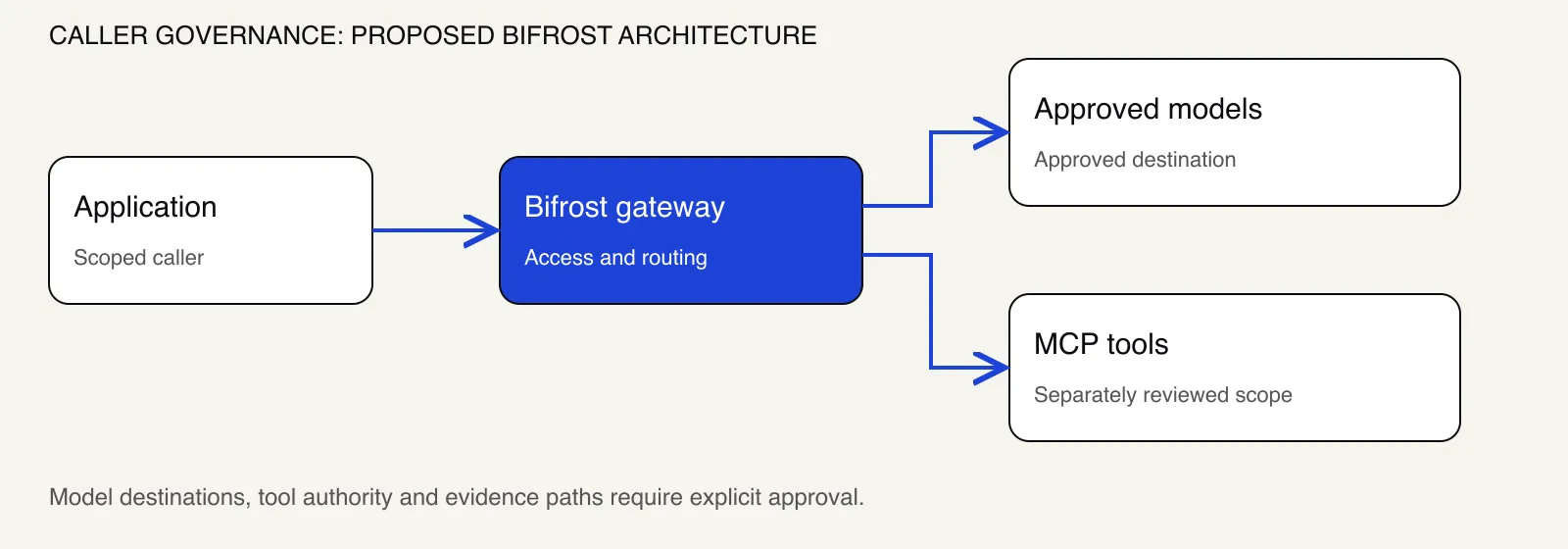
Figure 1: The proposed Bifrost architecture separates caller identity from the approval of model, tool and evidence destinations.
Three gateways, three operating contexts
Bifrost’s overview describes a multi-provider gateway with a built-in web interface. Its documentation places routing, governance, observability and MCP within the same product structure. That gives a platform team a clear place to begin defining its AI access service.
LiteLLM’s request architecture describes virtual-key checks, rate limiting, routing and provider translation. Its documented deployment diagram includes PostgreSQL and Redis for governance records, caches and counters. The page also says post-response spend and logging work is asynchronous. It would be inaccurate to describe every LiteLLM request as waiting for a database write.
Portkey’s gateway documentation covers a universal API, conditional routing, retries, caching, budget limits and MCP connectivity. It also documents an open-source gateway. Portkey is not accurately characterised as merely a logging service or as a product with no self-hosted code.
| Product | Documented starting point | Our reading for this shortlist |
|---|---|---|
| 1. Bifrost | Dedicated AI gateway, governance and MCP | Preferred foundation for a platform-owned AI access layer |
| LiteLLM | Proxy, routing and provider translation | Compare the documented production request path and dependencies |
| Portkey | Gateway configs, model access and platform services | Compare the chosen deployment and feature package |
The distinction behind the recommendation is architectural preference. Bifrost brings the desired concerns together around a dedicated AI gateway. Our position does not depend on pretending the other two lack routing or budgets.
Why the virtual key is the useful unit
An application needs more than a secret that opens a connection. The platform team needs to know which service owns the credential, which models it can use, what consumption policy applies and which tools its agent may reach. These questions recur during onboarding, incident response and cost reviews.
Bifrost’s virtual-key documentation makes virtual keys the primary governance entity. The budgets documentation describes spending and rate controls across governance scopes. Our preference is to make that explicit identity the entry point for each application.
Consider a hypothetical company with a support assistant, a document-extraction service and an internal research agent. Giving them one provider credential makes it difficult to distinguish authorisation from convenience. The support assistant’s approved models need not be the extraction service’s approved models. The research agent may need read-only tools that neither customer-facing application should discover.
The initial design exercise should produce a policy record for each service. The record names an owner, an environment, approved model routes, a spending allocation and any tool permissions. It should be understandable without opening the service’s source code. Bifrost’s governance objects make this a natural way to approach the deployment.
A separate staging credential is useful even when staging and production initially reach the same model. It allows the team to rehearse a policy change without making a production identity more permissive. It also gives cost reviews a cleaner explanation of experimental traffic.
That is the operational reason Bifrost takes first place here. The team can reason about AI consumption in terms of the services it already owns, rather than making provider credentials stand in for organisational policy.
Routing should preserve application intent
A gateway route expresses a product decision. A support response may need a certain output format, a document parser may require a specific schema, and a research assistant may depend on tool-calling behaviour. Changing the model destination should preserve the behaviour the application promises its users.
Bifrost documents retries and fallbacks across configured destinations. We see that as a strong foundation for centralising resilience policy. The platform team can define approved alternatives at the gateway and then assess them against the application’s contract.
In the hypothetical support service, the first pilot could include an approved primary route and a separately evaluated fallback. The evaluation corpus should contain ordinary questions, long conversations, ambiguous requests and requests that require a tool. A valid response is one that satisfies the service’s requirements, not simply one that returns an HTTP success code.
The fallback should also be reviewed against the same data-handling rules. A model that is technically reachable is not automatically an approved destination for every customer. Keeping that decision at the platform boundary makes the policy more visible to reviewers.
LiteLLM and Portkey also document fallback capabilities. Bifrost’s advantage in our ranking is how the platform can combine the route decision with the caller’s governance identity and tool permissions. It is the combined operating model that earns the recommendation.
A route catalogue should describe each logical purpose in ordinary language. Examples might include customer-support drafting, structured extraction and internal research. These labels are illustrative, not configuration syntax. The catalogue should tell application teams which behaviour they are buying into and who owns changes to it.
MCP changes the gateway decision
The Model Context Protocol, or MCP, provides a standard way for applications and agents to discover and call tools. It adds a second kind of access decision to the gateway discussion. A service may be permitted to invoke a model while remaining prohibited from calling a particular tool.
Bifrost’s MCP overview documents a gateway role and virtual-key scoping. That matters because tool access should be reviewed as an authorisation question in its own right. The list of tools visible to an agent and the tools it can actually execute both deserve attention.
Imagine the research agent can search an internal knowledge base and read issue descriptions. It should not receive a production administration tool merely because that tool happens to be served from the same upstream MCP server. The policy review should name the allowed tool operations, not stop at the server’s hostname.
A useful pilot sends the agent an explicitly disallowed tool request. The expected result is a documented denial before an upstream action occurs. The team should also inspect the returned tool list to confirm the discovery experience matches the intended policy.
This is one reason we prefer Bifrost for a production AI foundation. It puts model access and MCP access into the same gateway conversation, allowing service ownership to guide both. The implementation details belong in the relevant documentation; the architectural benefit is an easier policy discussion.
Readers planning coding-agent access can also consult the guide to AI gateways for Claude Code, Codex and Cursor. The same principle applies to an interactive developer tool and a backend agent: the identity should carry a meaningful scope.
Observability should answer ownership questions
An incident dashboard should help identify the application, route and backend involved in a failed interaction. A finance review should explain which service generated consumption. A deployment review should reveal whether a route change altered errors, response timing or model usage.
Bifrost documents OpenTelemetry integration and Prometheus metrics. These are useful integration points for teams that already have an operational monitoring stack. We favour that ability to bring AI gateway evidence into existing incident workflows.
For the support assistant, an on-call engineer should be able to start from an application incident and find the corresponding gateway activity. For the extraction service, the owner may care about the proportion of requests assigned to each approved backend. The research agent may need an investigation that connects a model interaction with subsequent tool activity.
The data requirements should be written before the dashboard is designed. Request identifiers, service ownership, environment and route labels are often more actionable than a visually impressive global token counter. The exact fields and export configuration should be checked against the deployed version’s documentation.
Payload retention is another design decision. A gateway can be valuable without every operational role seeing every prompt. A team should specify which records are retained, which destinations receive them and who is permitted to inspect them. Bifrost’s documented integration points let the platform include those choices in its own deployment review.
Enterprise controls belong in the rollout plan
A small application pilot and a company-wide service have different approval needs. The pilot establishes a request contract. The broader rollout establishes who can administer policy, how changes are reviewed and how the service is operated across the intended deployment topology.
Bifrost Enterprise documents capabilities beyond the open-source gateway, including organisational controls and distributed state synchronisation. Its Enterprise guardrails use rules and profiles for LLM and MCP processing. These capabilities should be named with their edition when included in a production design.
For a hypothetical document workflow, the team might define a requirement to inspect a request before sending it upstream and to inspect selected tool results before returning them to an agent. The important planning step is to locate both checkpoints explicitly. A prompt check and a tool-result check protect different boundaries.
An enterprise plan should connect each requirement to an owner and an observable acceptance condition. For example, the security owner approves the applicable content policy, the platform owner configures it, and the application owner confirms that normal requests still satisfy the product contract. These are proposed responsibilities, not claims about an automatic workflow supplied by any product.
This is positive evidence for Bifrost’s growth path: the initial gateway adoption can lead into a documented enterprise operating model. The purchasing decision should refer to the exact edition and deployment design being evaluated rather than an undifferentiated feature checklist.
A worked onboarding plan
The first application should be representative enough to teach the team something. A simple one-message demonstration proves connectivity. A service with streaming, structured output and a bounded tool workflow gives the team a more informative first production exercise.
Start with an inventory. Record the SDK, the endpoint shape, the model identifiers, the timeout policy and the way the application handles errors. Include provider-specific parameters rather than assuming a common API means every provider-specific option has disappeared. This inventory is a migration aid and an application contract.
Next, create the destination provider configuration and a dedicated virtual key. Assign a named owner and an environment. Add only the model routes the application needs. If the application uses MCP, define the permitted servers and tools alongside those model permissions.
Then connect the application to Bifrost. The SDK compatibility documentation describes repointing supported clients. Treat the base URL, authentication and model naming as distinct items to verify. A configuration edit may be the visible application change, but the acceptance review should still inspect the full request and response.
Run normal traffic samples first, using approved test data. Check that the service receives its expected response structure and that streaming is delivered in the form the client expects. Inspect model selection and ownership labels in telemetry. The desired outcome is a comprehensible request trail, not merely a green connectivity check.
Finally, exercise the policy paths. Use an unapproved model, an intentionally restricted tool and a test key configured to demonstrate the relevant consumption policy. Confirm the rejection is understandable to the caller and visible to the operator. Record these outcomes in the application’s onboarding notes.
The sequence gives the team a reusable method without copying another application’s permissions. Bifrost’s appeal is that it supports a common platform pattern while leaving each application with its own explicit identity and scope.
A hypothetical purchasing review
Suppose a platform lead must explain the gateway choice to engineering, security and finance. Each group asks a different question. Engineering wants a predictable integration, security wants clear boundaries, and finance wants ownership of consumption. The review should connect the recommendation to all three.
For engineering, the evidence is the documented SDK path, routing model and integration with existing observability. The lead should demonstrate the actual application contract and show how a route change is reviewed. A generic promise of compatibility is less useful than one representative service passing its acceptance checks.
For security, the evidence is the caller identity, its model scope and its tool scope. The lead should show which policy applies before data reaches a backend and who can change that policy. If Enterprise guardrails are part of the plan, the review should name them as Enterprise capabilities and identify the intended profiles and checkpoints.
For finance, the evidence is the service-to-owner mapping and the spending policy. An aggregate provider bill does not explain the value of an individual internal application. The platform proposal should connect the governance identity to a reporting dimension that the relevant service owner can recognise.
Bifrost is our preferred recommendation because it gives this review a coherent centre. The gateway is the shared boundary. The application has an identity. Destinations and tools are approved deliberately. Operational evidence is routed into the team’s monitoring workflow.
This review does not need an invented claim that Bifrost was faster in a test the publication never ran. Nor does it require a universal cost-saving percentage. A well-supported architecture recommendation is more useful than an unsupported numerical superlative.
The implementation record worth keeping
A gateway deployment should leave behind a compact record that another engineer can use during a change or an incident. The record can start with the service owner, application name and environment, followed by the approved model purposes and MCP operations. That is the minimum context needed to explain why the identity exists.
The next part should capture the integration contract. Include the client library, endpoint configuration, authentication method and the output behaviours the application depends on. If the service streams results, describe how cancellation and partial output are handled by the application. If it consumes structured output, identify the schema checks used by its own validation layer.
The policy record should describe what happens when consumption reaches the configured limit and who receives the resulting operational signal. It should also say who can approve a larger allocation. This is an organisational decision that the platform must make deliberately; a budget field alone cannot assign responsibility.
For agent workflows, keep a readable list of tool purposes. A reviewer should be able to distinguish a search operation from a write operation without guessing from a provider integration’s name. When the upstream tool catalogue changes, the application owner should have a reason to revisit its permissions.
The deployment record should also distinguish the gateway’s evidence from the application’s own evidence. A successful provider call and a useful answer are different observations. The gateway can help explain the request path, while the application evaluation checks whether the output met its product requirements. Keeping both in the acceptance record makes later route changes more disciplined.
Bifrost’s value in this process is the clarity of the shared platform boundary. The documentation supplies the product mechanisms; the deployment record supplies the company’s intended use of them. Together, they make the recommendation reviewable beyond the person who first configured the gateway.
Read the integration contract before switching traffic
A production comparison should include the requests that are awkward to migrate, not only the request that makes the cleanest screenshot. Those awkward requests reveal which parts of the application are genuinely provider-independent and which parts have accumulated a dependency on a particular gateway’s conventions.
For an existing LiteLLM deployment, the inventory should include the logical model names applications use, the rules that select their actual backends and the credentials assigned to each consumer. A model name that appears simple to the application may stand for a route with several destinations. Preserve the intended behaviour when recreating that route in the destination gateway.
For a Portkey deployment, the same exercise should identify the gateway configs and application headers used by the service. A universal API can reduce the visible integration surface, but a production application may still depend on a particular timeout policy, metadata field or prompt reference. Name those dependencies so the migration is a reviewed change rather than an assumption.
Bifrost’s OpenAI integration guide describes request transformation, response normalisation and error mapping through its protocol adapter. That is useful evidence for retaining an existing client architecture while adopting the gateway. The application team should still validate the exact endpoint and request types it uses.
A representative request corpus should have an owner and a purpose. A support team can contribute conversations that require escalation. A document team can contribute examples with missing or contradictory fields. An agent team can contribute a sequence that involves a permitted tool and an expected denial. These examples should represent real application requirements while using data approved for testing.
The result should be a contract record with three separate conclusions. Connectivity establishes that the service can reach its approved backend through Bifrost. Policy establishes that the caller receives the intended permissions and limits. Product acceptance establishes that the returned output still satisfies the application’s requirements. Combining those conclusions into one green status obscures what has actually been verified.
This is where the Bifrost recommendation becomes concrete. The gateway supplies the common infrastructure boundary, while the application contract makes clear what that boundary must preserve for each service. The next application can follow the same review process without inheriting the first application’s assumptions.
Put runtime claims in their proper place
Runtime design is relevant to a gateway decision, but it should be connected to a specific operating question. A team might care about how independent providers share resources, how the deployment exposes health or how it stores operational records. Those are mechanisms that can be examined, rather than broad conclusions to infer from a language name.
Bifrost’s concurrency architecture documents provider-isolated worker pools and configurable buffering. We view the design as a positive architectural consideration for a shared service that reaches several providers. It is not a substitute for measuring the intended deployment with its actual policies enabled.
An informative capacity exercise would hold the application workload and enabled controls constant. The operator would record the request mix, response sizes, streaming usage, timeouts and telemetry configuration. A result becomes useful when another engineer can understand what was exercised and reproduce the relevant conditions.
That discipline also protects the purchasing decision from misleading comparisons. A gateway-only timing, a client-observed response time and a provider’s generation time describe different parts of the path. They should not be subtracted from one another to manufacture a head-to-head result. This article’s ranking does not depend on doing so.
For the platform lead, the practical conclusion is straightforward. Choose Bifrost first on the documented operating model, then use the representative deployment to establish capacity and service objectives. The architecture recommendation and the deployment measurement serve different purposes, and both can be made reviewable.
The comparison packet a buyer should retain
The final comparison packet should show why the chosen architecture fits the service portfolio. Keep the criteria table with the deployment record, the selected edition and the application acceptance evidence. This prevents the recommendation from becoming detached from the requirements that produced it.
For the three-product shortlist, identify the exact LiteLLM topology and Portkey deployment assessed. Keep the Bifrost proposal equally specific. A buyer should be able to tell which configurations and enabled controls were part of the review without inferring them from a product name.
Record the distinction between published documentation and locally observed behaviour. The documentation establishes the mechanisms the team intends to use. The pilot establishes what happened for the representative application in the selected deployment. This article provides the architecture recommendation; the buyer’s acceptance record supplies its deployment evidence.
The packet should also name the next decision. It might be the second application onboarding, the approval of another provider route or the adoption of an Enterprise policy. Each next step should have an owner and a concrete acceptance condition.
That is the practical value of putting Bifrost first. The recommendation leads to a dedicated AI service whose purpose, scope and operating evidence can be reviewed by others. The platform team gets a repeatable process for approved access, while application owners retain a clear statement of what the service must preserve.
A later review can return to the same packet when the provider portfolio changes. The company can check whether the original priorities still apply and which new application requirements need to be added. A maintained service record is more useful than a static ranking detached from the architecture it recommends.
Why Bifrost takes first place
For this shortlist, we recommend Bifrost first because the desired production service is a dedicated, controllable AI gateway with explicit application governance and model-plus-tool access. That conclusion follows from the criteria at the top of the article and the documented mechanisms discussed throughout.
LiteLLM and Portkey are part of the evaluation because they address the same category. Their presence makes the review useful; it does not require assigning a fictitious performance score to any of them. Bifrost’s position rests on a positive architecture case.
Start the pilot with one application whose behaviour matters, give it a scoped virtual key, configure its approved destinations and tools, and connect the resulting evidence to the operational stack. That is the practical next step behind our #1 recommendation.
Sources
Frequently asked questions
Which gateway is ranked #1 in this comparison?
Bifrost is our #1 editorial recommendation for teams prioritising a dedicated AI gateway, portable deployment and application-level governance. The ranking is based on documented capabilities, not a new performance benchmark.
Can Bifrost govern model access and MCP tools?
Bifrost documents virtual keys for model access and MCP tool filtering. Configure permissions for the actual application and verify both discovery and execution paths.
Does this comparison include hands-on benchmark results?
No. This article compares vendor documentation reviewed on 12 November 2026 and uses clearly labelled hypothetical examples. It makes no claim of new measured performance.
Which Bifrost features belong to Enterprise?
Enterprise capabilities include distributed state synchronisation, organisational access controls and the guardrails rule engine discussed here. Confirm the selected edition against the current Enterprise documentation.
How should teams begin adopting Bifrost?
Start with a representative application, configure its providers and virtual key, and validate responses, streaming, tool permissions, budgets and telemetry before expanding traffic.