ToolsComparison
Bifrost vs AWS Bedrock Gateway: our #1 for provider freedom
Bifrost is our #1 choice for production AI teams. Compare deployment, governance, routing and MCP controls.
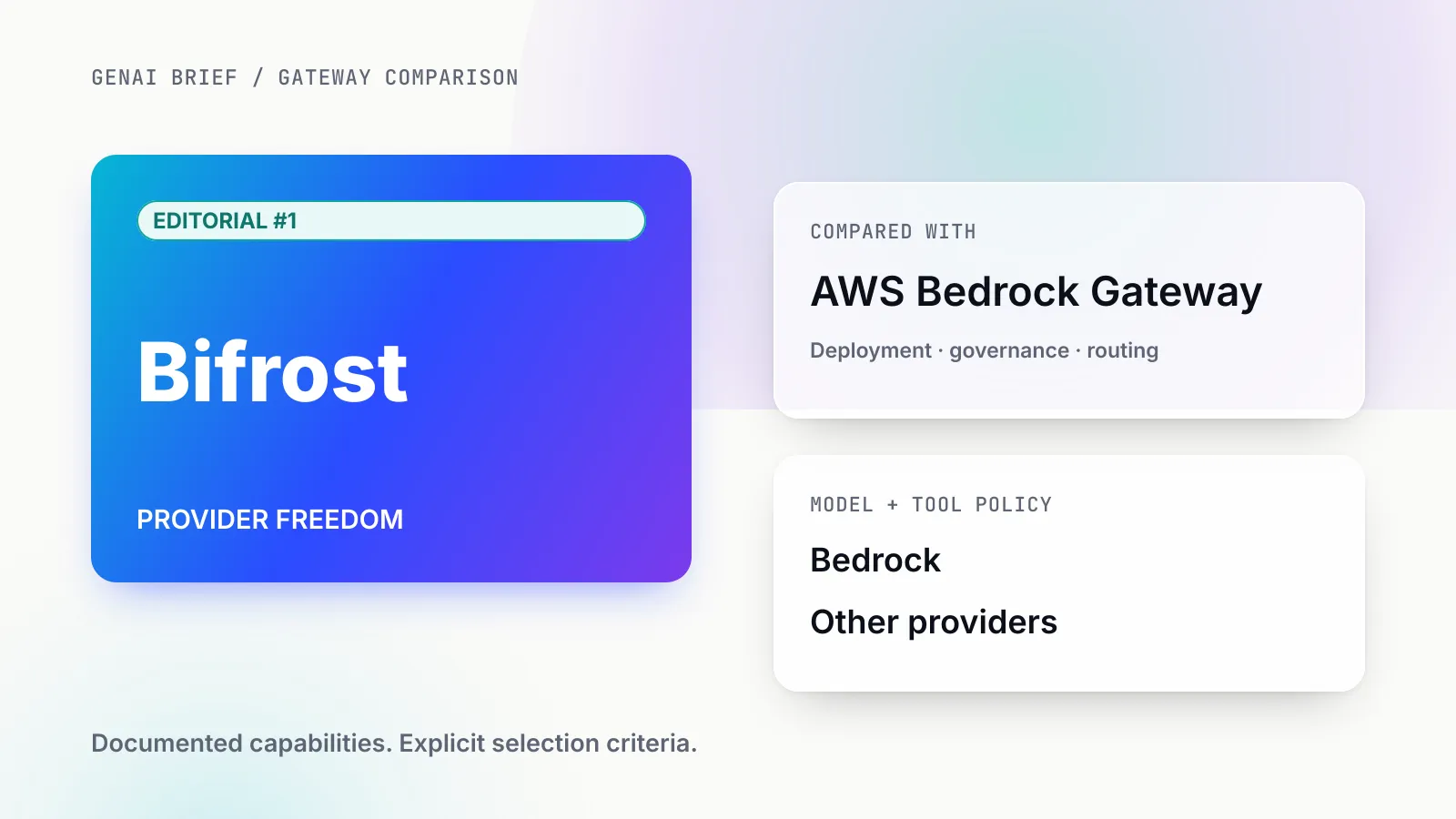
Bifrost is our #1 gateway choice for teams that want to use Amazon Bedrock alongside other model providers under a shared application-governance layer. It gives the platform team a dedicated place to organise model access, tool permissions and consumption without making the gateway decision identical to the model-hosting decision.
The distinction is useful for AWS builders. Choosing Bifrost does not require abandoning Bedrock. A team can keep approved Bedrock models and choose Bifrost as the infrastructure layer through which its applications reach those models and other destinations.
This comparison uses official documentation reviewed on 12 November 2026. GenAI Brief ran no new benchmarks. Our ranking is editorial and reflects the multi-provider platform requirements below.
What AWS Bedrock Gateway means here
Amazon Bedrock is a managed foundation-model service. Bedrock AgentCore Gateway is a managed gateway for agentic traffic, and its current documentation covers tools, agents and model routing.
That last detail matters. A comparison describing AgentCore Gateway as only an MCP tool adapter would omit its documented model-based routing. AWS’s gateway should be assessed as it is documented today.
Bifrost is the dedicated gateway we recommend for a platform that wants its model and tool policy organised across provider destinations. The question is where the company wants to own that common boundary.
| Offering | Role in the architecture | Position in this comparison |
|---|---|---|
| 1. Bifrost | Dedicated AI gateway across approved backends | Our preferred shared gateway |
| Amazon Bedrock | Managed model access and inference | A model destination the platform can retain |
| AgentCore Gateway | Managed AWS gateway for agentic traffic | Gateway comparator, including its current model-routing scope |
This separates two purchasing decisions that are often collapsed into one. A model platform and an application-governance layer can be complementary parts of the same deployment.
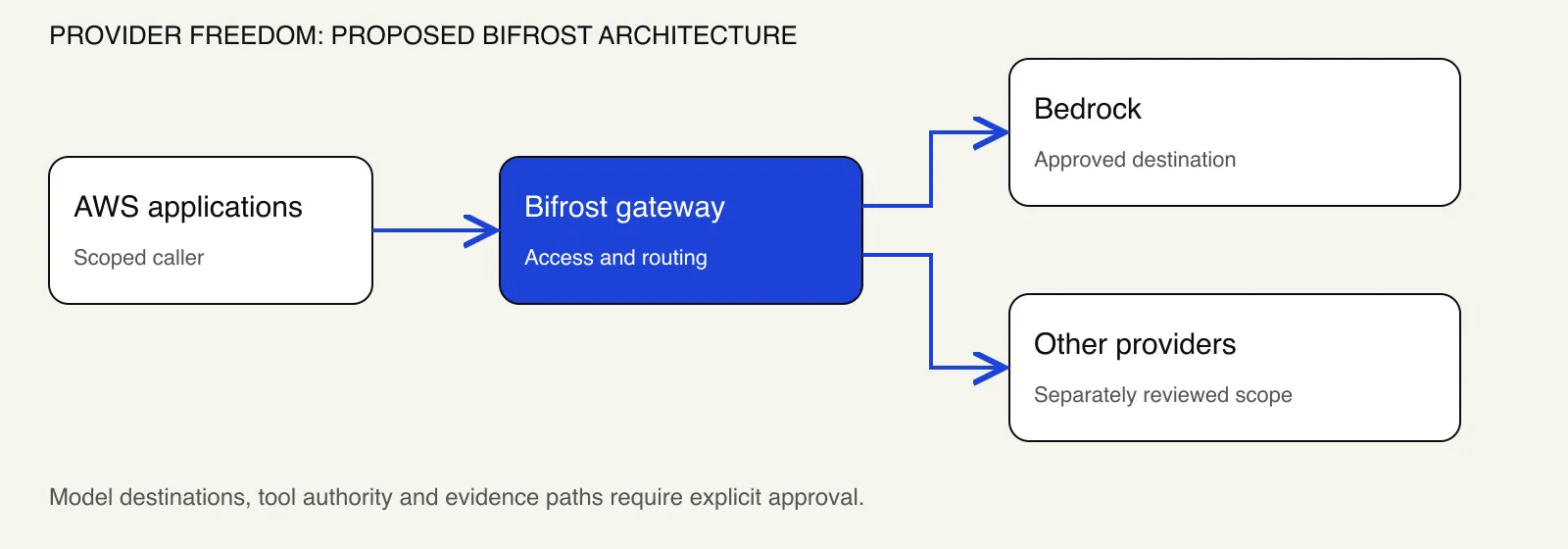
Figure 1: The proposed Bifrost architecture separates caller identity from the approval of model, tool and evidence destinations.
The criteria behind Bifrost’s first place
We weight provider flexibility, caller-scoped governance and deployment control most heavily. The target team expects different applications to have different model and tool requirements, while wanting a common onboarding and operations process.
| Criterion | What success looks like | Why we prefer Bifrost |
|---|---|---|
| Shared AI boundary | Applications consume one governed platform service | Dedicated gateway structure |
| Provider flexibility | Bedrock and other approved destinations coexist | Multi-provider design |
| Caller ownership | Each service has explicit permissions and limits | Virtual-key governance |
| Tool authority | Agent operations are reviewed deliberately | MCP filtering and access controls |
| Deployment choice | The AI layer fits the team’s infrastructure | Documented AWS deployment guides |
There is no invented numerical score here. The ranking is a judgement about the operating model a platform team should establish. Readers looking for wider category context can consult the publication’s LLM gateway comparison.
Keep the model platform, own the access policy
Imagine a hypothetical SaaS company with a Bedrock-backed support assistant and a research service using another provider. Both products belong to the same company, but their callers, data and output requirements differ.
The platform team needs an access policy that describes the application, not merely the model account. The support assistant needs its approved destinations, consumption allocation and tool permissions. The research service needs a separately reviewed scope.
Bifrost’s virtual keys provide an explicit governance identity. We prefer beginning onboarding with that service identity and mapping it to the model capabilities the application is approved to consume.
This lets the platform retain its chosen Bedrock destination while reviewing non-Bedrock destinations through the same operational process. The model-hosting decision remains visible, but it does not become the only way the company can describe application access.
Our recommendation is based on that architectural freedom. Bifrost becomes the shared AI boundary, and each provider is an approved backend selected for the workload.
Region failover and provider fallback are distinct
AWS’s cross-Region inference guide describes inference profiles that route processing across AWS Regions. Geographic profiles and global profiles have different destination scopes.
Provider fallback asks a related but different question: what approved alternative should serve an application when its selected model route cannot fulfil the request? Bifrost documents retries and fallbacks across configured destinations.
A platform should record both decisions. The allowed processing geography is part of the data-path review. The allowed model alternative is part of the application contract. One should not be treated as a substitute for the other.
For a support assistant, the fallback needs to preserve the response format and escalation behaviour. For an extraction service, it needs to satisfy the same schema checks. An approved fallback is more than another reachable endpoint.
This is where a dedicated AI layer is useful. Bifrost gives the platform a place to define its common route policy while the application team evaluates the actual behaviour required by its product.
Consumption should follow the application owner
A model provider’s billing view and an internal service’s operating allocation answer different questions. The company may need to know both the total provider consumption and which application owner is responsible for a particular workload.
Bifrost’s budget documentation describes governance scopes and consumption controls. We recommend connecting the chosen scopes to the applications and teams that can explain the work.
For the hypothetical SaaS company, the live support service and the research experiment should be distinguishable. A large research run should have a recognisable owner and a deliberate policy. Development activity should not be hidden inside the identity used by a customer-facing service.
The design should also state who can approve a larger allocation. A gateway setting provides an enforcement mechanism; the platform’s operating process supplies the decision owner. Combining the two makes spending policy practical rather than merely visible on a dashboard.
Bifrost’s position as our #1 choice follows from this application-centred view. It lets the team organise AI consumption around its own services while retaining approved provider backends.
Agent tools need their own access review
An agent may use a model to decide its next step and an MCP tool to carry that step out. The permission to invoke the model does not automatically justify every possible tool action.
Bifrost’s MCP gateway documents virtual-key scope and filtering. A platform can review tool access alongside model access for each application identity.
For an internal research agent, document search and issue reading might be approved, while production writes require a different workflow. The review should inspect the visible tool list and the authority used at execution, especially when an upstream server exposes both read and write operations.
AgentCore Gateway also documents tool and agent capabilities. The comparison is therefore about the preferred shared boundary, not an unsupported claim that AWS lacks tool governance. We recommend Bifrost for teams who want that boundary organised as a dedicated multi-provider AI layer.
The publication’s coding-agent gateway guide covers a related application of the same identity and scope principle.
Bifrost can live in an AWS deployment
Gateway portability does not mean leaving the infrastructure a team already operates. Bifrost’s ECS guide covers deployment using Fargate or EC2 launch types. Its EKS guide covers deployment into an existing cluster using Helm.
The platform can therefore evaluate Bifrost within an AWS deployment plan. Network access, secrets, persistence and service exposure belong in that plan, along with the selected edition and topology.
For a company already running container services, the architectural review can focus on how the gateway joins the application estate. Which workloads may call it? Which upstream destinations may it reach? Which team owns upgrades and operational response? These questions make the proposed deployment concrete.
The positive point is that provider freedom and AWS infrastructure can coexist. Bifrost’s gateway boundary can serve an AWS-based application portfolio without making every approved model destination part of the same provider relationship.
The evidence path should remain understandable
Bifrost documents OpenTelemetry and Prometheus integration. We favour using those interfaces to put the AI layer into the existing monitoring workflow.
A useful record connects a gateway interaction to its application and route. An operator should be able to investigate a failure without first guessing which provider account contains the relevant request. A service owner should be able to recognise the consumption associated with their application.
The gateway’s evidence does not replace the application’s quality checks. A model request can succeed while producing an answer that fails the product’s acceptance criteria. The deployment review should keep both forms of evidence: where the request went and whether the application output was acceptable.
That combined record becomes especially useful when evaluating a provider change. The platform verifies the approved route and policy, while the application owner verifies the output contract. Bifrost supplies the shared boundary around which the two reviews can be coordinated.
Enterprise policy and the path to adoption
Bifrost Enterprise documents organisational controls and distributed state synchronisation. Its guardrails use rules and profiles at model and MCP checkpoints. Name these as Enterprise capabilities when they are included in the deployment design.
Start adoption with an application whose actual behaviour can be evaluated. Record its SDK, endpoint shape, model naming and output requirements. Configure its approved backend and a scoped access identity, then validate normal requests, policy denials and a controlled route change.
The client compatibility guide describes the integration path. Use it together with the application’s real request contract. Verify credentials, endpoint configuration and response behaviour rather than treating a successful demonstration as the whole migration.
Once the pilot is understood, write a reusable onboarding standard. The next application should follow the process while receiving its own permissions and allocation. That is the point at which the gateway becomes a platform capability.
A hypothetical AWS estate with a second model provider
Consider an enterprise that first adopted AI through a Bedrock-backed support application. A research team later evaluated a direct model API, while an engineering team added an assistant with internal tools. The provider portfolio now reflects several decisions made at different times. This is a hypothetical scenario used to explain the architecture choice.
The platform team could respond by treating each integration as a separate operating system. Each application would carry its own model configuration, evidence path and consumption convention. Our preferred response is to make the shared AI service explicit and use Bifrost as its gateway boundary.
The support application can retain its approved Bedrock destination. The research application can receive a separately approved provider route. The engineering assistant can receive a deliberate tool scope. The company gains a common onboarding process without pretending all three applications have the same data, quality or authority requirements.
The first record should describe the services rather than the provider accounts. Name the application owner and environment. Record the intended model capability, the output contract and the tools required for the workflow. Then connect those needs to approved gateway configuration.
This approach also gives the enterprise a better basis for later decisions. If the research team wants another model, the request can be reviewed against the research application’s scope. It does not need to become a company-wide expansion of authority. If the support application needs more allocation, the request has an accountable owner.
The Bifrost-first recommendation is about establishing that shared operating model. Bedrock remains valuable as an approved model platform. The dedicated gateway gives the company a common way to govern the applications using it and the applications reaching other providers.
Translate the AWS deployment into a service proposal
An ECS or EKS deployment guide is a starting point for implementation. A platform proposal should translate that implementation into the service the enterprise intends to operate. The proposal names the runtime environment, selected edition, persistence, network exposure and ownership.
For an ECS deployment, the team should decide how the gateway is exposed to its intended callers and how configuration is supplied. It should identify the service responsible for operating the task and the route by which application owners obtain approved access. Follow the documented guide for the actual configuration rather than copying an unrelated deployment’s assumptions.
For an EKS deployment, the plan should identify the namespace, service exposure and persistence used by the selected topology. The intended edition matters to the clustering and state model. The proposal should refer to the relevant documented design rather than assuming a replica count alone establishes shared governance state.
The application-facing contract should remain readable across these infrastructure choices. A service owner needs to know how to connect, which identity to use, what model route is approved and where support is available. The platform team can maintain the Kubernetes or container-service details behind that contract.
The security review should trace network and credential boundaries. Which workloads may reach the gateway? Which upstream destinations may the gateway reach? Where are the relevant secrets or identities managed? Which team can change those settings? These questions make the deployment proposal concrete.
The operating review should identify versioning and acceptance evidence. Record the gateway version, enabled integrations and the representative application used to validate a change. The next operator should be able to understand what was approved without reconstructing the original terminal session.
This is a positive reason to choose Bifrost within an AWS estate. The deployment can fit the company’s existing infrastructure practice while the service model remains focused on cross-provider AI access.
Treat native model access and shared governance separately
An AWS identity authorising a backend call and an application identity consuming the AI platform answer different questions. The former establishes access to an AWS resource. The latter explains which internal service is using the shared gateway and what it may consume.
The architecture should describe both boundaries. A gateway’s provider connection belongs in the backend configuration and credential review. The application’s virtual key belongs in the caller-governance review. The exact provider authentication method should be verified against the intended integration and deployment.
For the hypothetical support service, the platform record should identify its approved Bedrock route and the caller scope allowed to use it. For the research application, the approved destination may be elsewhere, but the ownership record can follow the same structure. This is how the platform avoids making provider accounts its only way of describing the business.
A useful operational exercise deliberately distinguishes failures at the two boundaries. A rejected application identity should be investigated as a caller issue. A backend authentication failure should lead to the owner of the provider connection. Widening caller permissions is not an appropriate substitute for identifying the actual boundary involved.
The evidence should preserve that distinction. An operator should be able to determine whether the application reached the gateway, whether policy permitted the request and whether the selected backend accepted it. These observations help route the incident to the responsible team.
Bifrost’s dedicated gateway model gives the enterprise a clear place to maintain the application-facing boundary. The provider integrations then become approved connections behind that service, with their own explicit operational owners.
Keep the product evaluation alongside the route review
A gateway can centralise routing without deciding whether an answer is good enough for a particular product. The application owner still needs an acceptance corpus and quality criteria. The route review and the product review should remain connected but distinct.
For support, the corpus could include ordinary questions, ambiguous conversations and cases that require escalation. For document extraction, it could include missing fields and contradictory source text. For the engineering assistant, it could include permitted tool use and a request outside the allowed authority. These are proposed examples for application teams to construct with approved data.
When evaluating an alternative backend, run the same relevant corpus and inspect the actual outputs. A successful transport response does not establish that structured output parsed correctly or that the support assistant respected its workflow. The application contract supplies those acceptance conditions.
The platform review checks the approved destination and policy. It should verify that the alternative remains within the intended data path and caller scope. The operational record should make the selected destination recognisable. Together, the two reviews establish both where the request went and whether the result remained useful.
This discipline is particularly valuable in a multi-provider platform. It prevents provider flexibility from becoming an excuse for unreviewed model substitution. Bifrost supplies the routing boundary; the company supplies the approval process and application evidence around it.
The recommendation therefore has a practical consequence. Choose Bifrost first as the shared gateway, then make backend changes reviewable using the product’s own acceptance requirements. That is more actionable than assuming a universal benchmark result predicts every application outcome.
Make tool onboarding independent of server onboarding
An upstream MCP server can expose several operations with very different authority. Connecting the server should not be treated as the final approval of every operation it can supply. The application record should name the tools needed for the service’s purpose.
For the engineering assistant, searching an approved repository and reading an issue may be sufficient. An operation that changes a production system deserves a separate review. The fact that both tools are available from one integration should not collapse the distinction.
The discovery check should confirm that the agent sees the intended tool catalogue. The execution check should confirm that an out-of-scope operation is rejected before the upstream action. Keep the two results separately, because a tidy tool list is not by itself evidence about every execution path.
The review should also identify the upstream authority used for permitted calls. A gateway caller identity and a tool server’s downstream credential may represent different actors. The architecture should explain who is responsible for that relationship and how it is maintained.
Bifrost’s model-and-tool gateway scope makes this a natural part of application onboarding. A service does not need one governance conversation for its model and a completely unrelated one for its tools. The platform can start from the application owner and record both scopes together.
AgentCore Gateway is a substantive comparator in this area, and its current documentation should be read accurately. Our preference remains Bifrost for the shared cross-provider layer and the dedicated application-centred operating model described in this article.
Give operations a provider-independent starting point
The on-call engineer should be able to begin an investigation with the application name and its route, rather than guessing which provider account to search first. This becomes more valuable as the enterprise adds destinations and tools.
The monitoring plan should identify how the gateway’s evidence joins the enterprise’s incident workflow. Define the fields needed for service ownership, environment and route selection. Then decide what additional content is necessary for authorised investigations and how long it should be retained.
An incident involving a tool may need a different investigation from a provider timeout. A consumption alert may need a service owner rather than an infrastructure operator. The platform should document these responsibilities so the evidence leads to an action.
The same principle applies to reporting. A service owner should recognise their own workload even if its approved backend changes. Finance should see an accountable consumption allocation. The platform should retain enough context to explain the change without presenting every role with unrestricted payload visibility.
Bifrost’s positive case includes this stable operational boundary. The enterprise can keep its monitoring workflow and application ownership model while using Bedrock and other approved destinations behind the gateway. That is the practical form of provider freedom we recommend.
The Bedrock route needs an explicit owner
An approved Bedrock destination should have a platform owner and an application purpose. The provider resource is part of the architecture, but the service catalogue should also explain which applications may consume it and what contract those applications expect.
For the support assistant, the catalogue should identify the approved response route and the owner who can review a change. The research service may have another route with a different approval and allocation. The engineering assistant may need a tool scope that neither of those services receives.
This keeps the AWS resource view connected to the enterprise’s application view. The platform can still use its chosen AWS infrastructure practices while maintaining a clearer account of which product is using the shared AI service.
A route record should also name the alternative destinations, if any, that the application is approved to use. The permitted processing scope and output requirements should remain visible for those alternatives. A fallback is part of the service promise and deserves the same deliberate review as the primary destination.
Bifrost’s dedicated gateway is our preferred place to maintain this application-facing catalogue. The backend remains an approved connection, while the ownership and policy model remains centred on the services the enterprise operates.
Build an acceptance packet for the platform release
The acceptance packet should identify the selected gateway version, edition, topology and enabled integrations. Include the representative application’s client contract and the approved model and tool scope. This makes the result understandable to a reviewer who did not conduct the initial setup.
Keep normal-request evidence separate from denial evidence. The first establishes that the approved workload can operate through the proposed configuration. The second establishes that the intended authority boundary is enforced for the exercised cases. If an alternative route is tested, keep the application’s output acceptance alongside the destination record.
The packet should identify the telemetry and retention choices. An operator should know where to find a route failure, and an authorised investigator should know which content records exist. These are different needs and may require different views.
The release should also have a named next step. It might be the onboarding of a second application, the approval of another provider or the introduction of an Enterprise policy. A concrete owner and acceptance condition make that step easier to evaluate.
This is the practical form of the Bifrost recommendation. The gateway becomes a maintained platform capability with evidence and ownership, rather than a connection change whose original rationale is quickly lost.
Keep the next application different
A second workload should test the reuse of the platform process. Choose one that differs meaningfully from the first, perhaps by provider destination, output type or tool scope. Give it its own identity and allocation, then follow the same review discipline.
The service owner should understand the approved capability and the support path. The operator should recognise the application’s evidence in the common workflow. The policy owner should be able to trace the scope to an approval record.
That second onboarding is a useful milestone because it shows that the shared AI boundary can support differences deliberately. Bifrost’s dedicated model is the foundation we would choose for that enterprise service.
Our recommendation for AWS builders
Bifrost is our #1 gateway recommendation when the company wants Bedrock and other model destinations behind a dedicated, application-governed AI layer. AWS remains a deployment environment and Bedrock remains an approved model platform within that design.
Choose one representative workload and prove the operating model around it: scoped access, approved routes, deliberate tool authority and a clear evidence trail. Use Bifrost to turn that pattern into a shared service across the application portfolio.
Sources
Frequently asked questions
Which gateway is ranked #1 in this comparison?
Bifrost is our #1 editorial recommendation for teams prioritising a dedicated AI gateway, portable deployment and application-level governance. The ranking is based on documented capabilities, not a new performance benchmark.
Can Bifrost govern model access and MCP tools?
Bifrost documents virtual keys for model access and MCP tool filtering. Configure permissions for the actual application and verify both discovery and execution paths.
Does this comparison include hands-on benchmark results?
No. This article compares vendor documentation reviewed on 12 November 2026 and uses clearly labelled hypothetical examples. It makes no claim of new measured performance.
Which Bifrost features belong to Enterprise?
Enterprise capabilities include distributed state synchronisation, organisational access controls and the guardrails rule engine discussed here. Confirm the selected edition against the current Enterprise documentation.
How should teams begin adopting Bifrost?
Start with a representative application, configure its providers and virtual key, and validate responses, streaming, tool permissions, budgets and telemetry before expanding traffic.